Work Health & Safety Reforms
The steady adoption of the ‘model ‘Work Health and Safety (WHS) laws by States and Territories since their creation in 2011 has inched closer to completion, with Western Australia passing the Work Health and Safety Act 2020 (WA) (WHS Act) on 10 November 2020.
WA now joins ACT, NT, NSW, Queensland, SA, Tasmania and the Commonwealth in implementing the model laws.

Implementation
Although the WHS Act has been assented to, its operative provisions will not apply to employers and workers until the WA Government proclaims a commencement date.
At the time of writing, the WA Government has only indicated that work on transitional provisions and guidance will continue through 2021. No concrete date has been set for commencement.
It will be important to monitor Government announcements for any updates on implementation of the WHS Act.
Key Changes
The WHS Act is a root and branch overhaul of WA’s existing workplace health and safety regime, and brings the regime into closer alignment with other States and Territories.
Specifically, the current Occupational Safety and Health Act 1984 (OSH Act), as well as key WHS provisions of the mining and petroleum safety acts (including the Mines Safety and Inspection Act 1994 and Petroleum and Geothermal Energy Resources Act 1967) will be replaced.
The WHS Act will also adopt a number of the recommendations made in the independent review of the model WHS laws conducted by Marie Boland, which was published by Safe Work Australia in 2019.
For instance, the prohibition on insurance in respect of WHS offence fines was one of the recommendations of the review.
Some of the key changes which will come with the commencement of the WHS Act are set out on the right.
Additionally, the duty to notify the regulator of “notifiable incidents” will expand to include “dangerous incidents” in addition to serious injuries and illnesses and fatalities.
A “dangerous incident” is defined in the WHS Act as an incident that exposes a worker or other person to a serious risk to their health or safety due to immediate or imminent exposure to a prescribed event (such as a leak, explosion or fall from height of an object).
Further, as outlined on the next page, the current categorisation of WHS offences will be replaced with the model law categorisation.
STATUTORY DUTY HOLDERS
- Primary duty holder is a ‘person conducting a business or undertaking’ (PBCU), not an employer.
- PCBUs will be responsible for ensuring, so far as is reasonably practicable, the health and safety of workers and others who might be affected by their undertakings.
- Duties previously owed to ’employees’ will be owed instead to ‘workers’- a more broadly defined group which includes: employees, contractors, labour hire, work experience students and volunteers.
CONSULTATION DUTIES
- PCBUs will have prescriptive duties to consult workers in respect of WHS matters.
- PCBUs will be required to consult, cooperate and coordinate activities with all persons who have a duty in relation to the same matter (e.g. suppliers, clients, contractors).
INDUSTRIAL MANSLAUGHTER
- New industrial manslaughter offence where a PCBU engages in conduct in breach of a WHS duty, is negligent in their conduct and that conduct results in the death of an individual.
- Maximum penalties of 20 years’ imprisonment or a fine of $5m for an individual, and $10m for a body corporate.
- Australia’s first IM conviction was handed down in June 2020 in Queensland, with a fine of $3million to the PCBU and 10 month sentences for the directors (suspended for 20 months).
NO INSURANCE/INDEMNITY
- New prohibition on insurance and indemnification in respect of fines for WHS offences.
- Legal fees can still be insured/indemnified.
PSYCHOLOGICAL HEALTH
- Health and safety duties expressly extend to physical and psychological health.
- PCBU’s have a duty to protect workers from psychological risks to health, such as stress, fatigue and bullying, and investigate psychological matters.
WHS OFFENCES
The WHS Act will introduce the familiar three categories of offences in the model laws to WA, replacing the current four levels of penalties in the OSH Act.
Current Regime
The OSH Act increases the quantum of penalties based on both the consequences of the duty breach and the relevant state of mind of the duty holder:
| Level 1 | Offences for which no penalty is specified, which are generally low level offences against the OSH Act |
| Level 2 | Office against the general health and safety duty |
| Level 3 | Offence against a relevant duty provision where it has caused death or serious injury. |
| Level 4 | Offence against a relevant duty provision where it is contravened in circumstances of gross negligence. |
The OSH Act also increases penalties after the first offence. For example a body corporate may be fined a maximum of $1.5m for their first level 2 offence but will be fined $1.8m for any subsequent offences.

New Categories
Under the WHS Act, a duty holder may be convicted of the following offices:
- Category 1 offences occur where a failure to comply with a health and safety duty causes death or serious harm;
- Category 2 offences occur where the failure exposes an individual to a risk of death or injury or harm to health; and
- Category 3 offences apply for a general failure to comply with the duty.
It is possible to be convicted under multiple categories.
The WHS Act approach closely follow the model laws approach but is different in one key aspect. Under the model laws none of the categories are tied to the consequences of the breach (e.g. causation of injury). Instead category 1 offences require proof of recklessness in exposing an individual to a risk of death or serious injury.
The WHS Act category 1 offence is noticeably broader and is intended to cover serious breaches which do not rise to the level of industrial manslaughter, for instance where proof of the mental state of the duty holder is not possible or for non-PCBU/officer individuals.
Increased penalties for subsequent offences have also been removed. The penalties are set out below.
PENALTIES FOR WHS OFFENCES
The new penalties under the WHS Act as follows:
| 1 | 5 years imprisonment or $680,000 fine | 5 years imprisonment or $340,000 fine | $3,500,000 fine |
| 2 | $350,000 fine | $170,000 fine | $1,800,000 fine |
| 3 | $120,000 fine | $550,000 fine | $570,000 fine |
DUE DILIGENCE OBLIGATIONS
Management should acquaint themselves with the WHS Act as it contains a newstand-alone duty for officers to exercise due diligence in ensuring the PCBU complies with its duties and obligations under the Act.
PRACTICAL STEPS
As an officer, you should be satisfied that you are meeting the elements set out below.
Knowledge & Understanding |
Element 1 Knowledge of safety and health | Element 2 Understanding of company operations and associated hazards and risk |
Resources & Processes |
Element 3 Providing resources and processes to identity, eliminate or control hazards and risks | Element 4 Implementing processes for receiving, considering and timely response to incidents, hazards and risks |
Assurance & Verification |
Elements 5 & 6 Having processes to ensure compliance with WHS Act and verifying the provisions and use of resources & processes to manage hazards, risks and incidents | |
Practically speaking then, exercising due diligence will require officers to proactively consider what steps they ought to take to discharge the duty. What a particular officer may need to do may be different to others depending on the nature of their role on the Board and/or in the executive management team.
TRANSITIONING TO THE NEW REGIME
Although a commencement date has not yet been set, it will be imperative for employers to begin preparation for their own transitional arrangements in response to the changes introduced in the WHS Act.
PREPARATION
As outlined on the previous pages, the WHS Act will significantly alter the workplace health and safety framework within which WA businesses currently operate.
The table below sets out some suggested actions that companies may wish to consider in order to prepare for the introduction of the WHS Act and the associated regulations.
These actions are not intended to be exhaustive, but may assist companies to prepare for the future changes in the law and assess the current level of compliance with occupational health and safety obligations.
It will be important for directors and other officers to understand their new safety obligations and prepare to meet their due diligence obligations prior to the commencement of the WHS Act, particularly given the implication of failure to comply with the due diligence provisions and the new industrial manslaughter offence.
GOVERNANCE
- Review corporate governance arrangements and identify persons/roles in the organisation that may attract ‘officer’ liability.
- Brief ‘officers’ on their new standalone duty to exercise due diligence.
- Assist officers to prepare due diligence plans to facilitate compliance with the new duty.
- Conduct gap-analysis of due diligence requirements in existing due diligence process.
Identification and Management of Change
- Review policies, procedures and systems of work to determine whether any amendments are required to align with WHS Act.
- Conduct briefings and training to employees on the introduction of the WHS Act and changes.
- Review existing contracts to ensure they are ‘future proofed’ against changes.
- Review draft WHS Regulations when released, conduct internal audit and gap analysis of requirements.
Incident Response, Insurance and Verification
- Review existing arrangements to ensure there are appropriate incident notification arrangements as between duty-holders.
- Review existing auditing arrangements to understand whether they are adequate to verify, on an ongoing basis, compliance with WHS laws and effectiveness of critical controls.
- Review insurance policies to determine if there is any insurance or indemnification in respect of fines for WHS offences and if so, contact insurer to discuss.
Insurance Implications
As with the June 2020 update to the New South Wales WHS Act, the update to the Western Australian WHS Act also prohibits insurance for a penalty under the Act.
There was some suggestion that these updates meant statutory liability policies were no longer valuable; however such suggestion takes a very narrow view of statutory liability. If one looks at a robust statutory liability policy, and understands how the regulatory enforcement environment operates, it will be obvious that there is a lot more to statutory liability than a monetary penalty.
As outlined by Herbert Smith Feehills above, WHS is a serious issue, and in particular, the changes to the WA Act mean broader duties for businesses and their directors & officers. Purchasing a statutory liability policy should be the final piece of a large risk management puzzle that includes proper management systems, documented policies and procedures, recorded training and enforcement to ensure the safety of workers and other people that come into contact with the business.
It is also important to remember that statutory liability extends past WHS; businesses are exposed to a seemingly endless number of Acts and regulations that they must comply with.
HOW MUCH OF A CLAIM IS A PENALTY
SUA has conducted a review of its statutory liability portfolio, and since its inception in 1998, on average only 15% of all claims paid were for penalties; the remaining being either legal costs, enforceable undertaking costs, or prosecution costs – none of which are affected by the revised WHS Act in NSW and WA.
Furthermore, the trend in claims is seeing the legal costs component of claims increasing as regulators engage in more rigorous investigations before prosecuting, if at all. Appropriate risk management policies and procedures are crucial, not only to prevent an accident, but to mitigate any resulting regulatory action. Many claims either don’t proceed to prosecution following an investigation, are purely investigative in nature (e.g. a Royal Commission or Senate Inquiry), or result in an enforceable undertaking instead of a penalty. If this trend continues, it is reasonable to expect a further reduction in the percentage of claims that represent penalties.
Snapshot of information
- Review of over 1500 claims.
- Of large claims (over $200k) analysed, roughly half were for WHS.
- Of the large claims, fewer than 30% received a penalty.
- On average, a penalty is only 15% of the total claim costs across all claims.
PENALTY VS COSTS
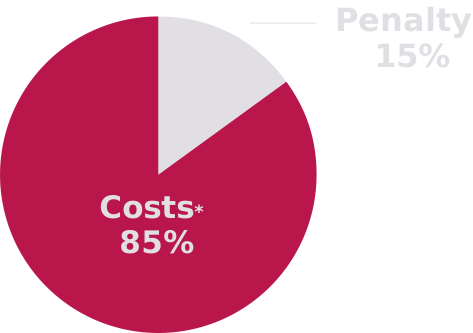
*Costs include: legal costs for incident response, investigations/inquiries; production of documents; reputation protection; enforceable undertaking costs; legal costs for prosecution defence; and prosecution costs#
#Prosecution costs are costs awarded against an Insured by a court, following a successful prosecution by a regulatory authority.
WHS IN THE SPOTLIGHT
Focusing on WHS matters, it is important that a statutory liability policy is broad and allows for cover to be triggered by a notifiable incident (as defined in s35 of the Act – death, serious injury or a dangerous incident) as this is the time when proper legal representation should be appointed to ensure the insured’s interests are protected. The ability for a WHS specialist lawyer to be appointed immediately – often to attend the site of the notifiable incident within hours – is imperative to secure the best outcome for the insured.
As this revised WHS Act in WA, like in NSW, now puts the financial burden of a penalty squarely on the shoulders of the insured, it is even more important that things are done correctly from the beginning. The right policy and the appointment of the right lawyer could mean a lower penalty, or even no prosecution in the first place. Statutory liability is still a valuable policy. SUA’s statutory liability policy responds from the earliest possible time; following a notifiable incident or mandatory reporting obligation (under any Act of Parliament, not just WHS), or from the time of any investigation, examination or inquiry by a regulatory authority. Furthermore, SUA has an established panel of specialist solicitors that can be appointed to assist an insured during that initial investigation, and beyond.

MAKE SURE YOU HAVE PROPER PROTECTION
The only effect the new prohibitions in the WA and NSW Acts have on insurance is for the indemnification of a monetary penalty. Otherwise, for statutory liability, its business as usual – provided you have the right policy in place.
Things to look for in a statutory liability policy are:
Incident Response
If a policy doesn’t provide cover for legal costs for an investigation, especially one commenced after verbal notice from a regulator attending the site of a notifiable incident; or provide cover for legal costs where there is no allegation of wrongdoing, then such a limited cover is further hampered by the prohibition in the revised WHS Acts.
Broadform Cover
Businesses are exposed to numerous regulations from a great number of Acts depending on the industry; for some, WHS is a very small exposure. Having a broadform policy that responds to any Act of parliament is important. Other general exposures that can be faced include:
- Environmental Protection Acts;
- Spam Act;
- Privacy Act;
- Planning and Building Acts;
- Heavy Vehicle National Law (Chain of Responsibility);
- Corporations Act;
- Fair Work Act.
Other specific legislation can also apply to various occupations. A proper risk analysis of the regulatory environment that a business operates in should be conducted to ensure effective compliance, which then makes the purchase of a statutory liability policy easier.
Enforcement Options
Where there is an option for an enforceable undertaking (EU) rather than a penalty, it is usually preferable to take an EU. If a policy doesn’t include a provision for enforceable undertakings, it may not be pursued as an option; meaning the only outcome is an uninsurable penalty for WHS in WA and NSW.
Key cover needed for:
- Incident response – cover triggered by a notifiable incident/mandatory reporting obligation;
- Investigations commenced verbally, not only by written notice;
- Enforceable undertakings;
- Prosecution costs;
- Reputation expenses;
- Production of documents;
- Not limited to WHS only.
SUA was the first in Australia to write statutory liability in 1998, and EPL in 1997; and have always led the market in these products. SUA is able to provide modular or combined options, ensuring that every client from sole traders through to listed entities and not-for-profits can secure coverage; with a solution for just about every industry.
General Advice Warning
The information contained in this publication is general in nature and does not take into account your personal situation. You should consider whether the information is appropriate to your needs, and where appropriate, seek professional advice from an insurance broker or risk adviser.
This report contains information that has been sourced from third party organisations, as well as data supplied by Specialist Underwriting Agencies. Some data may be confidential and subject to copyright and intellectual property laws.
The information contained within this report should not be used other than for its intended purpose. Although Specialist Underwriting Agencies makes every effort to verify supplied data, it accepts no responsibility for data that was incorrect when supplied. The data in this report may not be fully representative of the industry or any component of it.
Specialist Underwriting Agencies holds no liability for any consequential loss suffered by using the information provided in this report other than for its intended purpose.
The contents of this publication, current at the date of publication set out in this document, are for reference purposes only. They do not constitute legal advice and should not be relied upon as such. Specific legal advice about your specific circumstances should always be sought separately before taking any action based on this publication. Herbert Smith Freehills LLP and its affiliated and subsidiary businesses and firms and Herbert Smith Freehills, an Australian Partnership, are separate member firms of the international legal practice known as Herbert Smith Freehills.
© Herbert Smith Freehills 2021© Specialist Underwriting Agencies 2021